Written by Tarék | March 31, 2026
Most of you may not understand. While a few of you are well aware. Today is New Year’s Eve. Making tomorrow mark the actual start of the New Year. Is it not?
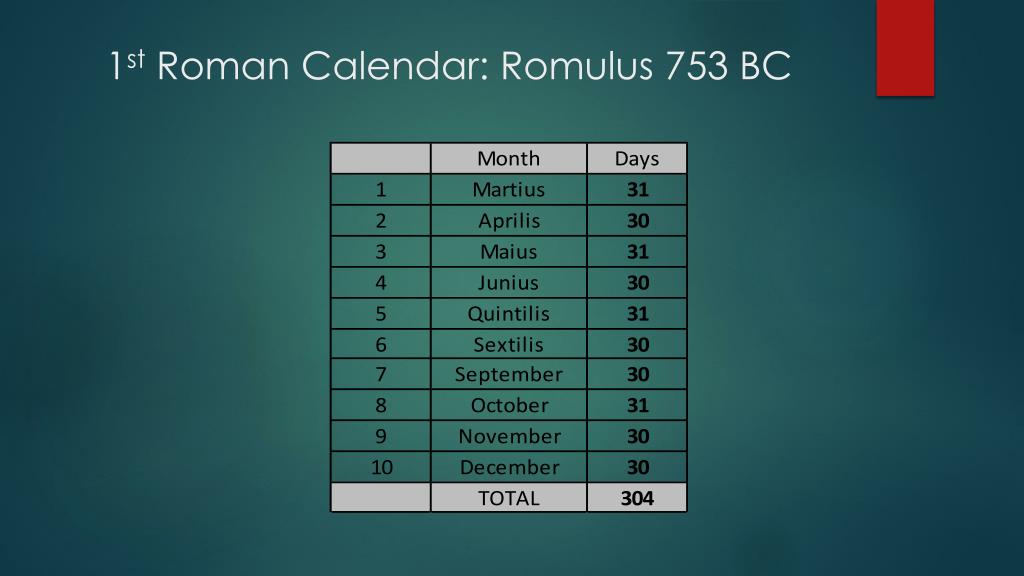
Many calendars began their monthly year with March 25 and ended with December 25. Martius (March), Aprilis (April), Maius (May), Junius (June), Quintilis (July), Sextilis (August), September (September), October (October), November (November), December (December). This 10-month calendar year was created in 738 BCE/BC by Romulus (first King of Rome and its namesake). It was lunar-based and totaled 304 days, completely ignoring 61.25 days. Talk about confusing times.
It was during the reign of Numa Pompilius (2nd King of Rome, 715 BCE/BC to 672 BCE/BC) that the calendar would have January and February added to the year in circa 713 BCE. January would replace March as the first month and February would end the year. This in part to sync with the solar year cycle. It wasn’t until 452 BCE that February would move to be placed between January and March.
Circa 46 BCE Julius Caesar would rectify the Roman calendar matching it with the commencing of consuls’ terms. It deemed fitting that January represent the beginning of the year. You see, January was named after the Roman god, Janus, guardian of the gates and doorways, Janus is portrayed with two faces, one viewing the past, the other peering into the future. In ancient Rome, the gates of the Temple of Janus (constructed by King Numa Pompilius) stood open during war and were shut in times of peace. This calendar was introduced as the Julian Calendar. Though there were errors, this calendar was more accurate to the solar year and included a leap year every four years. This replaced the chaotic lunar calendar created by earlier Romans and brought the days to tally up to 365.25.
Soon after the fall of Rome in the 5th century CE/AD, a vast amount of Christian countries returned the calendar to the New Year beginning in March and ending in December. This was a direct reflection of their religion. March 25 being the Feast of the Annunciation and December 25 being Christmas. However, customarily, April 1 became the start of the year. At least in some regions.
It is believed that this current switch of the new year from March to January is due in part of the Gregorian calendar, instituted by Pope Gregory XIII, following the papal bull Inter gravissimas. It was introduced in 1582 and went into effect in October of the same year. However, it is apparent that this switch was not designed to create a new system. Only, a proposition to pay homage to the past in returning the calendar to King Numa Pompilius’ calendar celebrating the New Year on January 1 and ending December 31.
It was in 1752 AD/CE that the U.S. would adopt this change to their calendars.
ALMANAC
January – Named after the Roman god of Janus, the guardian of gates and doorways. It would possess two faces. One viewing the past, while the other face peered into the future.
February – The Latin word februa, “to cleanse.” The Roman calendar month of Februarius was named Februalia, a festival of purification and atonement during this period.
March – Named after the Roman god of wars, Mars. The time of year to resume military campaigns interrupted by winter. March was also a time of many festivals, presumably in preparation for the campaigning season.
April – From the Latin word aperio, “to open (bud),” plants begin to grow in this month. In essence, this month was viewed as spring’s renewal.
May – Named for the Roman goddess Maia, who oversaw the growth of plants. Also, from the Latin word maiores, “elders,” who were celebrated during this month. Maia was considered a nurturer and an earth goddess, which may explain the connection with this springtime month.
June – Named for the Roman goddess Juno, patroness of marriage and the well-being of women. Also, it comes from the Latin word juvenis, which means “young people.”
July – Named to honor Roman dictator Julius Caesar (100 B.C.– 44 B.C.) after his death. In 46 B.C., Julius Caesar made one of his most significant contributions to history: With the help of Sosigenes, he developed the Julian calendar, the precursor to the Gregorian calendar we use today.
August – Named to honor the first Roman emperor (and grandnephew of Julius Caesar), Augustus Caesar (63 B.C.– A.D. 14). Augustus (the first Roman emperor) comes from the Latin word augustus, meaning “venerable, noble, and majestic.”
September – September comes from the Latin word septem, meaning “seven,” because it was the seventh month of the early Roman calendar.
October – Was originally the eighth month in the ancient Roman calendar, named from the Latin octo (“eight”). Though later renamed attempts were made, the name stood. In Old England, it was called Winmonath (“wine month”) for the grape harvest and Winterfylleth (“winter full moon”), marking winter’s start.
November – From the Latin word novem, “nine,” this had been the ninth month of the early Roman calendar.
December – From the Latin word decem, “ten,” this had been the tenth month of the early Roman calendar.
There are many beliefs as to why the calendar switched various times. Some believe it was because of taxes, politics, the inclusion of the winter season, the lunar/solar cycle, or to simply fix chaotic confusion. However, here we are in the year of 2026 on the 31st day, wrapping up the 3rd month of this Gregorian calendar year.
Please, comment below your thoughts.